12 nov. 2026
COP31 in Antalya: No Deal, and a Signal Worth Holding On To
GEAF
24 nov. 2026
12 minutes de lecture
COP31 closed in Antalya on Sunday 22 November, two days after its scheduled end, as the longest UN climate conference on record. It also closed without an overarching agreement, the first time since Copenhagen in 2009 that the annual talks have ended without a cover decision (Fisher, 2026; World Desk, 2026). This is not the outcome anyone hoped for. But the way the talks ended, and the voices that shaped them, deserve a closer look.
What happened in Antalya
The third and final draft of the proposed Antalya Pact was released in the early hours of Sunday. It made no reference to coal, oil or gas, recalled the 2023 Dubai commitment to transition away from fossil fuels without naming them, and replaced an earlier proposed target of at least US$120 billion a year for adaptation finance by 2035 with a vaguer pledge to triple funding. More than 130 countries had sought to reaffirm the Dubai language (Fisher, 2026).
The European Union, Norway, the United Kingdom and Panama objected, and the Marshall Islands withheld its support, saying the text failed frontline countries (Fisher, 2026; UN News, 2026; World Desk, 2026). COP31 President Murat Kurum told the closing plenary that there was no agreement and that the decisions had not been adopted, having said earlier that he would put forward no new text. UN Secretary-General António Guterres called the outcome deeply disappointing, saying that there may be no consensus in the room but there is "no ambiguity in the science" (UN News, 2026). Major fossil fuel producers, including Saudi Arabia and Russia, had resisted stronger language throughout (Fisher, 2026).
The voices that kept the bar high
Indigenous Peoples. In their opening statement on 9 November, the International Indigenous Peoples Forum on Climate Change described their rights as non-negotiable and called on Parties to commit to a full phase-out of fossil fuels. Their seven regional demands included rights-based adaptation, direct access to climate finance and governance, and an Indigenous-led pathway within the Fund for responding to Loss and Damage. They also asked COP31 to put the rights recognised at Belém into practice, including in the design and governance of the just transition mechanism (International Indigenous Peoples Forum on Climate Change [IIPFCC], 2026). In the negotiating rooms, Indigenous Peoples organisations pressed for free, prior and informed consent (Earth Negotiations Bulletin, 2026c) and, on adaptation, for direct access to climate finance and a place on the technical taskforce (Earth Negotiations Bulletin, 2026b).
Youth. Global South youth representatives from Latin America, the Caribbean and Southeast Asia demonstrated inside the venue on 18 November, urging governments to keep language on accelerated fossil fuel phase-out, and rejecting carbon capture, fracking and nuclear power as substitutes for cutting emissions. They called for new public, grant-based finance for developing countries, including for loss and damage (Nganga, 2026). In the negotiating rooms, youth constituencies pressed for stronger commitments on 1.5°C (Earth Negotiations Bulletin, 2026c). The Children and Youth Pavilion, open for its fifth consecutive year as the only fully youth-led space at the conference, provided a platform for this work (News On AIR, 2026).
The Global South and frontline states. The Alliance of Small Island States supported a transition away from fossil fuels and delivery of finance commitments, including replenishment of climate funds for loss and damage (Earth Negotiations Bulletin, 2026b). The Least Developed Countries insisted that the cover decision include concrete adaptation measures (Earth Negotiations Bulletin, 2026a), and the African Group sought to give tripling adaptation finance its own agenda item (Novak, 2026). Positions were not uniform: Ghana, for the African Group, said it would not block consensus despite shortcomings on finance, loss and damage and just transition (UN News, 2026), and India, for the Like-Minded Developing Countries, said it was willing to move forward despite discomfort with parts of the text (World Desk, 2026). That diversity makes the broader message more notable: communities and countries living with the sharpest climate impacts consistently asked that any outcome match the reality they face.
Why the deadlock is a signal, not only a setback
A text that omitted fossil fuels and diluted adaptation finance did not become the world's agreed position. Some analysts, including Fatima Eisam-Eldeen of the University of Barcelona, argue that no agreement is better than a weak one that could have rolled back the Dubai commitment (Fisher, 2026). The Paris Agreement, a ratified treaty, remains in force, the Dubai decision of 2023 remains the political reference point, and the next global stocktake is due in 2028 (Fisher, 2026).
Some work also stands independently of the failed text. A standalone climate finance work programme and a consultation on mountains and climate change were already on the agenda adopted on the opening day, and stand apart from the failed cover decision, while more than 90 countries backed a separate electrification initiative (Fisher, 2026). UN Climate Change Executive Secretary Simon Stiell pointed to an agreement on a just transition and a series of Action Agenda initiatives on electrification, resilience and investment, and urged governments to learn from Antalya, saying the world cannot afford a repeat (UN News, 2026). COP32 will be held in Addis Ababa in November 2027 (World Desk, 2026), the first COP hosted by a least developed country (Wyns, 2025).
None of this softens the facts. The WMO reports that 2026 will be one of the four warmest years on record, with January to September about 1.47°C above pre-industrial levels (World Meteorological Organization [WMO], 2026). UNEP puts international public adaptation finance at US$28.2 to 31.7 billion in 2024, only US$1 billion more than the year before, against needs of about US$305 billion a year by 2035, and the first round of the Fund for Responding to Loss and Damage drew US$2.8 billion in requests against US$342 million available (United Nations Environment Programme [UNEP], 2026). But the clarity that Antalya produced, about who is asking for what and where the lines are, is a foundation that Addis Ababa can build on. In that sense, the deadlock can mark the beginning of an important milestone rather than the end of one.
Echoes of Copenhagen, and what is different
Antalya is being compared with Copenhagen in 2009, the last time a COP ended without an adopted overarching outcome (World Desk, 2026). The comparison is useful, but the two differ in what failed, why, and what remained afterwards.
LL
|
|
Copenhagen, 2009 (Bodansky, 2010) |
Antalya, 2026 (Fisher, 2026) |
|---|---|---|
|
What was sought |
A new global regime to succeed the Kyoto Protocol |
A cover decision applying the existing Paris framework, centred on fossil fuels and adaptation finance |
|
Outcome |
A political accord negotiated by about 25 leaders and ministers; the conference only "took note" of it |
No text adopted, and the presidency offered no further text |
|
Who objected |
A small group led by Sudan, Venezuela, Bolivia and Nicaragua, objecting that negotiating the accord in a smaller group bypassed the formal meetings |
The EU, UK, Norway, Panama and the Marshall Islands, objecting to what the text lacked: any reference to fossil fuels |
|
Finance |
US$30 billion pledged for 2010 to 2012, and a goal of US$100 billion a year by 2020 |
A proposed adaptation target of at least US$120 billion a year by 2035 was dropped for a vaguer pledge to triple funding |
|
Legal standing |
Political and not legally binding; no successor treaty agreed |
The Paris Agreement, a ratified treaty, remains in force, and the Dubai decision remains the political reference point |
|
What followed |
The Paris Agreement came in 2015 |
COP32 in Addis Ababa in November 2027; the next global stocktake in 2028 |
The central difference is the nature of the objection. In 2009 it was largely about process: a deal struck by a few leaders, with a group of developing countries protesting that it bypassed the formal talks. In 2026 it was about substance: countries refused a text they judged too weak on fossil fuels and finance. In 2009, after an all-night session, delegates agreed to "take note of" the accord (Bodansky, 2010); in 2026 there was no such outcome to note. History does not promise the same arc twice. But the Paris Agreement was reached six years after Copenhagen, and Antalya starts from a framework that already exists.
What it means for GEAF and grassroots organisations
Antalya changes the terrain, not the task. With no new global text, the commitments already made, in Paris and Dubai, remain the reference point, and delivering them depends even more on governments at home and on communities, young people and civil society organisations. For grassroots groups working on climate change, five implications stand out.
Do not wait for the negotiations. Tree planting, water stewardship, community education and youth engagement never depended on a cover decision. The existing framework still stands, and local action is how it becomes real.
Plan for tight finance. International public adaptation finance stands at roughly US$28 to 32 billion a year against needs of about US$305 billion by 2035 (UNEP, 2026), and the proposed US$120 billion target was dropped (Fisher, 2026). Small organisations should diversify funding, build partnerships, look to regional funds and keep clear records of results. Pacific officials are already looking to regional funds and partnerships outside the UN process (Streamline Newsroom, 2026), and Indigenous Peoples are asking for direct access to finance and a say in how it is governed (IIPFCC, 2026).
Evidence and stories carry weight. Negotiators act on arguments, and the most persuasive come from communities living with the impacts. Documented experience from the field, on water, land, food and youth, is what turns demands into text. GEAF's Ambassador and Facilitator network across more than 40 countries is well placed to gather it.
Use participation as a standard. The Indigenous and youth demands made at COP31, including rights-based approaches, free, prior and informed consent, and inclusion of women, youth and persons with disabilities (IIPFCC, 2026; Earth Negotiations Bulletin, 2026c), are also a useful checklist for grassroots programmes. Organisations can hold themselves to the standards they ask of governments.
Prepare early for Addis Ababa. COP32 will be the first held in a least developed country (Wyns, 2025). Grassroots groups can use the year ahead to engage their national delegations and Action for Climate Empowerment focal points, and to build the skills of young people who will carry their messages. For GEAF, the Ambassador Programme and the Emerging Diplomats Academy are part of that pipeline.
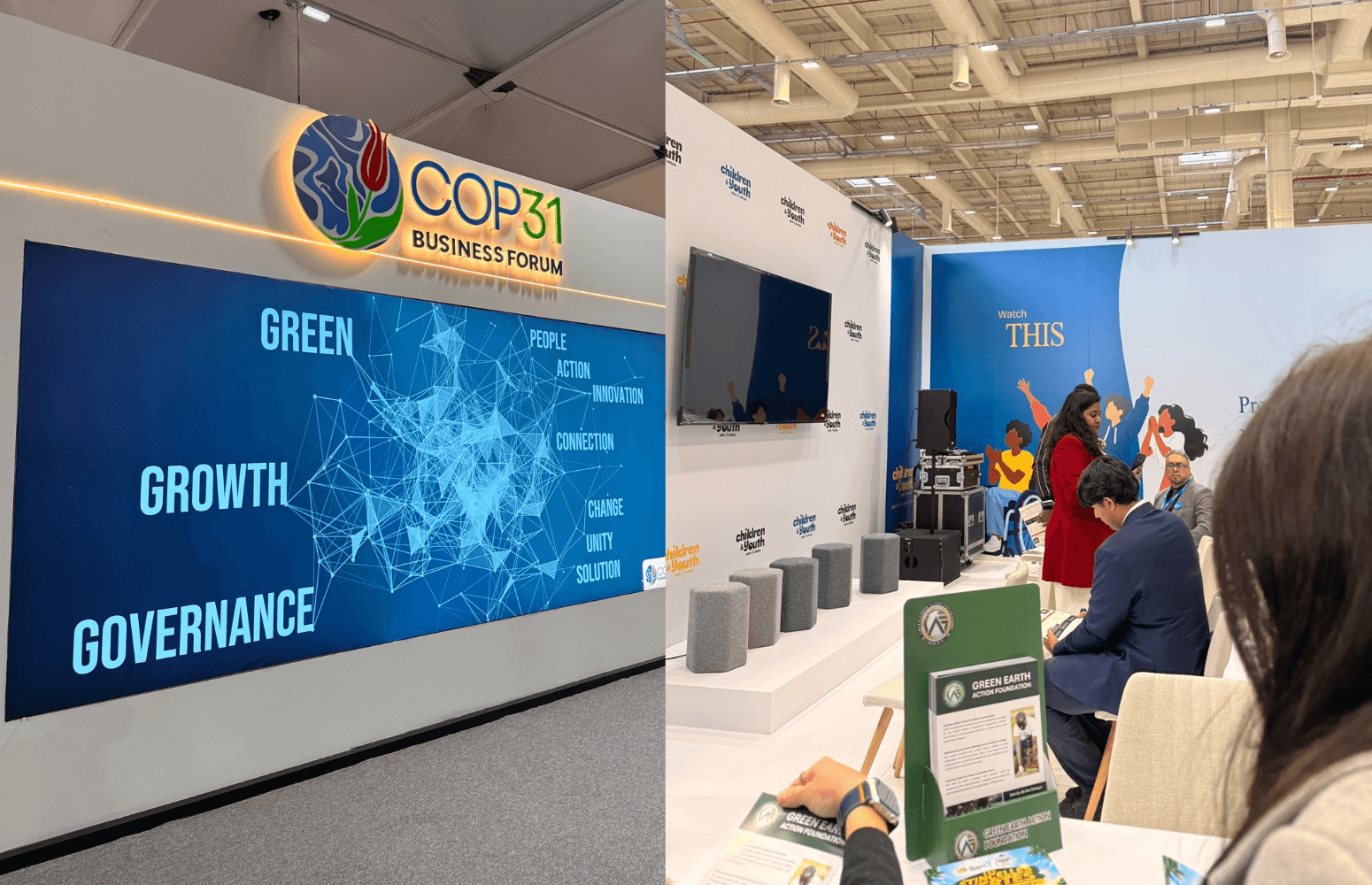
GEAF's COP31 work shows the model in practice: the Ambassador Programme presentation at the Children and Youth Pavilion, with testimony from Pakistan Ambassador Pirah Siyal; the launch of the Emerging Diplomats Academy at the Liberia Pavilion; and the screening of ACT II, led by Bangladesh Ambassador Tapas Kumar Mollick, at the GLF symposium. In each case, grassroots experience was carried into global spaces.
Antalya did not deliver the agreement the science demands. It did show that voices from the frontlines, from Indigenous territories and from a new generation will not accept less than their reality requires, and that is something to build on. As GEAF moves into the Transition phase of its ACT series, that is the spirit in which we continue: rooted in hope, and in action.
References
Bodansky, D. (2010, February 16). The Copenhagen climate change accord (ASIL Insights, Vol. 14, No. 3). American Society of International Law. Retrieved November 24, 2026, from https://asil.org/insights/volume-14-issue-3/
Earth Negotiations Bulletin. (2026a, November 14). Antalya Climate Change Conference: Friday, 13 November 2026 (Vol. 12, No. 906). International Institute for Sustainable Development. Retrieved November 24, 2026, from https://enb.iisd.org/sites/default/files/2026-11/enb12906e.pdf
Earth Negotiations Bulletin. (2026b, November 18). Antalya Climate Change Conference: Tuesday, 17 November 2026 (Vol. 12, No. 909). International Institute for Sustainable Development. Retrieved November 24, 2026, from https://enb.iisd.org/sites/default/files/2026-11/enb12909e.pdf
Earth Negotiations Bulletin. (2026c, November 12). Antalya Climate Change Conference: Wednesday, 11 November 2026 (Vol. 12, No. 904). International Institute for Sustainable Development. Retrieved November 24, 2026, from https://enb.iisd.org/sites/default/files/2026-11/enb12904e.pdf
Fisher, N. (2026, November 22). COP31 collapses without deal as EU rejects fossil fuel omission. HNGN. Retrieved November 23, 2026, from https://www.hngn.com/articles/273927/20261122/cop31-collapses-without-deal-eu-rejects-fossil-fuel-omission.htm
International Indigenous Peoples Forum on Climate Change. (2026, November 9). Opening statement at COP31 [Statement read by Q. Pirihi]. Cultural Survival. Retrieved November 23, 2026, from https://www.culturalsurvival.org/news/international-indigenous-peoples-forum-climate-changes-iipfcc-opening-statement-cop31
News On AIR. (2026, November 12). Children & Youth Pavilion opens at UN Climate Change Conference COP31 in Antalya. Retrieved November 24, 2026, from https://newsonair.gov.in/children-youth-pavilion-opens-at-un-climate-change-conference-cop31-in-antalya/
Nganga, R. (2026, November 19). COP31 fossil fuel phase-out fight intensifies as Global South youth reject carbon capture and nuclear power. African Sustainability Matters. Retrieved November 24, 2026, from https://africasustainabilitymatters.com/cop31-fossil-fuel-phase-out-fight-intensifies-as-global-south-youth-reject-carbon-capture-and-nuclear-power/
Novak, C. (2026, November 10). COP31 opens with mounting climate warnings, persistent divisions. To Vima. Retrieved November 20, 2026, from https://www.tovima.com/climate/cop31-opens-with-mounting-climate-warnings-persisten-divisions/
Streamline Newsroom. (2026, November 20). COP31 draft drops fossil fuel exit, pivots to carbon capture. Streamline. Retrieved November 20, 2026, from https://streamlinefeed.co.ke/news/cop31-draft-drops-fossil-fuel-exit-pivots-to-carbon-capture
United Nations Environment Programme. (2026). Adaptation Gap Report 2026: Ready? Not. Climate impacts will not wait. Adaptation finance must rise. Retrieved November 24, 2026, from https://www.unep.org/en/publications/report/adaptation-gap-report-2026
UN News. (2026, November 23). COP31 ends without climate pact as UN chief warns there is "no ambiguity in the science". Eurasia Review. Retrieved November 24, 2026, from https://www.eurasiareview.com/23112026-cop31-ends-without-climate-pact-as-un-chief-warns-there-is-no-ambiguity-in-the-science/
World Desk. (2026, November 23). COP31 climate summit: UN talks end without deal as fossil fuel row blocks pact. The Open Press. Retrieved November 23, 2026, from https://theopenpress.in/article/cop31-no-deal-fossil-fuel-antalya
World Meteorological Organization. (2026, November 9). State of the climate in 2026 gives new meaning to phrase "off the charts" [Press release]. Retrieved November 24, 2026, from https://wmo.int/news/media-centre/state-of-climate-2026-gives-new-meaning-phrase-charts
Wyns, A. (2025, December 1). Multilateralism lives to fight on as dust settles on UN climate talks. Devpolicy Blog. Retrieved November 24, 2026, from https://devpolicy.org/multilateralism-lives-to-fight-on-as-dust-settles-on-un-climate-talks-20251201/
Partager